by Bobbi Jones Sabine
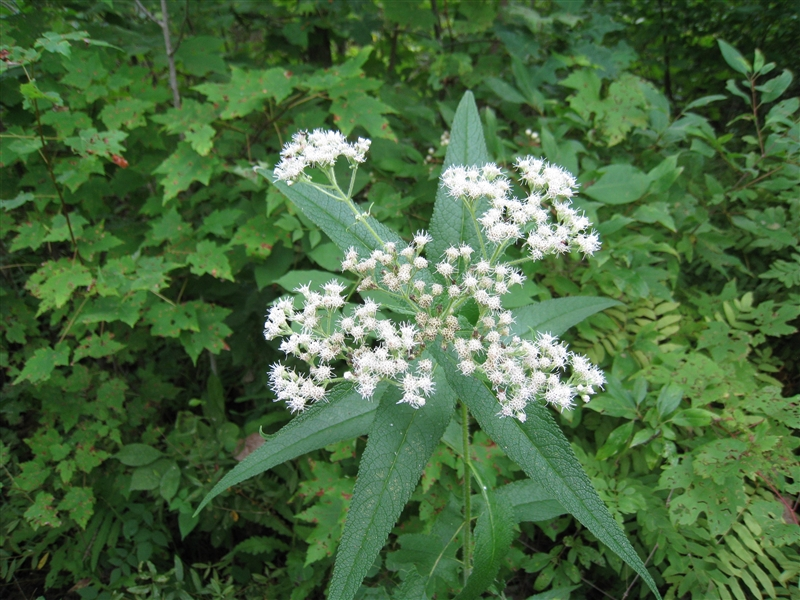
Boneset (Eupatorium perfoliatum) has a host of other common names, including agueweed, thoroughwort, feverwort, Indian sage, and sweating weed. A member of the Aster family, it loves moist soils and can be found in late summer/early fall in marshes, swales, fens, swamps, damp meadows, and along rivers and streambanks.
The name “boneset” is believed to be derived from its use in treating “breakbone fever,” a colloquial term for dengue fever, where sufferers experienced extreme body aches that felt like bones breaking.
One of four Eupatorium species in Michigan, it occurs very frequently throughout the entire state, with records in nearly every county. It’s native to eastern Canada and the U.S., ranging from Nova Scotia to Florida. It is typically 2 to 4 feet tall.
This fragrant white-flowered perennial plant is often found along with Joe-Pye weed, which thrives in the same habitats. The “perfoliate” stem appears to pass right through the leaves, thus the descriptor. Many species of bees and butterflies love the flowers.
Boneset tea is used in traditional medicine as a cold and flu remedy. It should never be ingested fresh as it has a toxic volatile oil which is neutralized by drying the plant. Though bitter-tasting, it has immune-boosting, antibacterial, and anti-inflammatory properties to help fight off infection. It was used as a digestive aid, and to lessen muscle and joint aches. Some people believed it helped broken bones heal faster. Clinical trials showed it equally effective to aspirin. Indigenous peoples of North America used it to promote sweating to help a fever pass, and some groups used it as a hunting charm.